Friday, September 11, 2009

The future of cataloging : insights from the Lubetzky symposium : April 18, 1998, University of California, Los Angeles

'Modeling Relevance in Art History', Sara Shatford Lane, p. 33
The first task, then, was to figure out what art historians are studying; the second, to figure out what the attributes of art works are; the third, to figure out how to match up the two; and the fourth and final, to analyze the data.
'Creating Efficient and Systematic Catalogs', Allyson Carlyle, p. 42

Tillett's Taxonomy of Bibliographic Relationships as a Scheme for Display
  • Equivalence Relationships, including:
    • equivalent texts, which share identical content and authority
    • near equivalents, which in addition to identical content and authorship, share other characteristics as well    honestly, I can't understand this pair of sentences.  Why are 'near  equivalents' more alike than equivalents?  Do I not understand the word 'equivalent'?  I always thought 'equi' was relating to equal, or the same.  Or it's related to horses.
  • Derivative Relationships, including:
    • revisions
    • adaptations
    • translations
    • extractions
    • amplifications
  • Whole-Part Relationships
  • Sequential relationships
  • Descriptive Relationships
  • Shared Characteristic Relationships

Tuesday, September 1, 2009

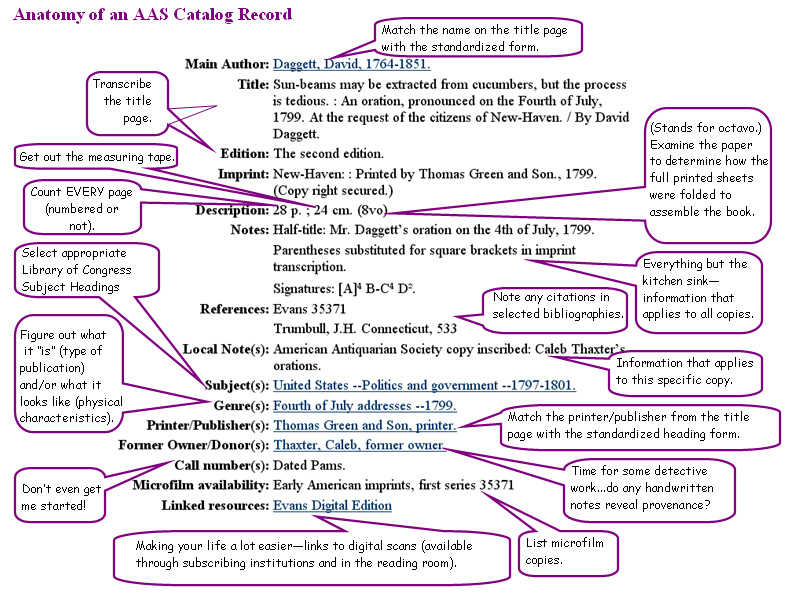
The standard catalog entry and how it can be applied to a carrot

Some explanatory notes:

Black Ink text comes from my notes on the AACR2 Standard Rules   striken-through means I realized it was not used for carrots.
Green Ink text comes from my notes on how it can be applied to a carrot
Red Ink text denotes further reading from the AACR2 chapter on Artefacts and Realia.  (yes, artEfacts, it means an object made or modifies by one or more persons) (no, artEfacts is just the British way of spelling artIfacts, it isn't a different thing)
Important: spelling the word carrot too many times makes it never looked spelled correctly.
  • Title and Statement of Responsibility what would the title of a vegetable be?  AACR2 says if it is Realia, a brief descriptive title is ok, but to [bracket a devised title]  For example:  Carrot [realia]?  I don't know yet.  There is NO statement of responsibility for a carrot and AACR2 says do not make one up.  In Realia, the chief source of information is the object itself with any accompanying container. [carrot]  Statement of Responsibility could contain first farmer to hybridize, first discoverer, but this would be in the Notes section.  Which is now looking to be the main part of a Realia entry.
    • title proper = parallell title (other languages only if well known) : other title information  Title Proper versus Collective Title versus Uniform Title.  Peppers.  For separate iteations of this species, see   Jalapeno.  For separate iterations of this genus see   Vegetables.
  • Edition none for a carrot unless it is a second planting, I guess
  • Publication and Distribution  no place of publication because it is a naturally occurring object.
    • place and name of publisher
    • name of distributor
    • place and name of manufacturer
    • dates maybe could be date of planting and date of harvest? In Realia, date of publication becomes date of manufacture.  I could put the time from germination to harvest.
  • Physical Description
    • extent of item : other physical details ; dimensions.  Carrot : orange; 17 x 6 cm.  Or, Pecan; in shell 5 x 7 x 8 cm (world's largest) (not really, I'm just making numbers up) MARC record format is object : material, color ; dimensions.
  • Series (current iteration or all issues and parts)   see my notes in the notes
  • Notes (all iterations and any other sources)
    • nature, scope or artistic form  nature of the item...edible part of Carrotus Americanus. 
    • language generally english but garbanzo beans might not be english
    • source of title like Rodale's Guide maybe
    • variations commonly known as 'tater.
    • edition and history could be: grown in the United States since 1845.
    • physical decsiption ovoid object made of carbon, hydrogen, etc. ?
    • series If I am describing a crop as opposed to a single iteration, would it be a series? Carrot, no. 17. If I do two plantings could I say, Carrot; v.2, no.17?
    • audience for all mammals with scondary molars
    • other formats maybe issued also in sizes from 2x2 cm to 17x18 cm.
    • summary
    • contents If there is more than one usaeble part- contents: edible seeds - flesh - root
    • numbers associated maybe for apples 3 would be associated because of some Trinity thing
    • copy being described specific details about that carrot that may be different than the usual: has extra root so it looks like a little man.
    • library's holdings  garden conatins 75 carrots.
    • restrictions on use  for humans only, not intended for rodent or lupine (rabbit) visitors.
    • Standard number and Terms of Availabilty Accessible after 23 days of growth.  Inaccessible after October 15 (first frost date)
    • references The See and the See Alsos.  For a tomato could be See: Love apple.  For the collective species you could say, See Also, root vegetables.  And then in the Root Vegetable entry you'd have to put See Also, Carrot, Parsnip, etc. ' See'  leads one way, See Also has to be two-way.

AACR2 and the hidden frustrations of blogging as a tool for school

it ate it all. twice.